
Spinifex Vision Pipeline on Cisco UCS
A YOLO11m detection and Qwen2-VL captioning pipeline streaming from a shared Predastore bucket across two EC2 instances, with Intel AMX and NVIDIA L4 compared.
Overview
Spinifex is an open-source infrastructure platform that brings core AWS services — EC2, S3, EBS, VPC and EKS — to bare-metal, edge, and on-prem deployments. It exposes a fully AWS-compatible API, so standard tooling (the aws CLI, Terraform) works against a Spinifex cluster unchanged, with a single profile/endpoint swap.
This guide walks through a computer-vision pipeline built on a 3-node Cisco Unified Edge cluster running Spinifex: real-time object detection plus a vision-language model producing plain-English scene descriptions, both streaming from the same shared Predastore (S3-compatible) bucket as two entirely independent EC2-compatible instances.
Companion documents: Spinifex Platform Benchmark on Cisco UCS · vLLM Serving on Cisco UCS: Intel AMX vs NVIDIA L4
Platform
| Component | Specification |
|---|---|
| Chassis | 3× Cisco Unified Edge, single-socket each |
| CPU | 1× Intel Xeon 6543P-B per node — 32 cores / 64 threads, 800 MHz–3.30 GHz |
| Cache / NUMA | L3 128 MB (unified), single NUMA node per host |
| ISA | AVX-512 (F/DQ/BW/VL/VNNI/BF16/FP16), Intel AMX (tile/BF16/INT8), VT-x, VT-d |
| Memory | 499 GiB usable per node (≈1.5 TiB aggregate) |
| GPU | 1× NVIDIA L4 (23,034 MiB) via VFIO PCIe passthrough on one node; the other two nodes are CPU-only |
| Storage | 4× KIOXIA CD8P NVMe (1.92 TB each) per node, raw — Predastore/Viperblock claim these directly |
| Boot | Cisco SATA RAID VD (Marvell 88SE9230 controller) |
| Network | 2× Intel E825-C 25GbE ports per node — one bond for management/WAN (VLAN 1337), one for storage/cluster traffic (VLAN 1336, full 25GbE) |
| Aggregate | 96 cores / 192 threads, ~1.5 TiB RAM, ~23 TiB raw NVMe, 1× L4 GPU |
Workloads
| Instance | Role | Engine | Node |
|---|---|---|---|
cpu1 (m8i.2xlarge) | Real-time YOLO11m object detection | OpenVINO, CPU (AMX/BF16) | either CPU-only node (spread placement group) |
gpu (g6.2xlarge) | Qwen2-VL-2B scene captioning | PyTorch/Transformers, NVIDIA L4 | the GPU-equipped node (only one of three has an L4) |
cpu2 (m8i.2xlarge) | Consolidation/failure-testing capacity | OpenVINO, CPU | either CPU-only node (spread placement group) |
The detection worker reads a frame from Predastore, runs YOLO11m, and posts the annotated frame; the captioning worker independently reads the same raw frame from Predastore and produces a one-sentence description with Qwen2-VL-2B — two instances, two different accelerators, one shared object store.
Architecture
AWS services exercised
| Service | Role |
|---|---|
| EC2 | 3× guest instances (1 GPU, 2 CPU), spread placement group — one instance per physical node |
| S3 (Predastore) | Central image bucket; both YOLO and VLM workers read from it independently over HTTPS |
| EBS (Viperblock) | Root + dedicated data volume per instance — survives instance termination/replacement independently |
| VPC (OVN) | Overlay networking between guests |
Prerequisites
- 3-node Spinifex cluster installed and services healthy on all nodes — follow the Multi-Node Install guide.
- VPC, network pool, SSH key pair, and security group configured — see VPC Networking and Launching Instances
- GPU passthrough configured on the one node with the NVIDIA L4 — see GPU Passthrough:
sudo spx admin gpu setup   # reboot required after this step
sudo spx admin gpu enable- AWS CLI configured with
AWS_PROFILE=spinifexpointing at the cluster endpoint (https://<host>:9999) - OpenTofu >= 1.6 installed locally
Clone the workbook
git clone https://github.com/mulgadc/cisco-ucs-vision-pipeline
cd cisco-ucs-vision-pipeline
Instructions
1. Provision the three instances
cd terraform/
terraform apply
One g6.2xlarge (GPU) and two m8i.2xlarge (CPU) instances in a spread placement group — Spinifex schedules spread-group members onto distinct physical nodes, so each instance lands on a different one of the three. The gpu instance must land on the one node with GPU passthrough configured; the spread group guarantees the two CPU instances land on the remaining two nodes. A dedicated Viperblock data volume per instance (separate from the root volume, delete_on_termination = false) survives instance termination/replacement independently — relaunching a terminated instance reattaches the same volume rather than starting from empty storage.
gpu_instance  = { id = "i-...", public_ip = "192.168.12.151", type = "g6.2xlarge" }
cpu_instances = [
  { id = "i-...", public_ip = "192.168.12.152", type = "m8i.2xlarge" },
  { id = "i-...", public_ip = "192.168.12.154", type = "m8i.2xlarge" },
]
2. CPU (Intel AMX) vs GPU precision comparison
Before running the live pipeline, this section characterises each accelerator's throughput and accuracy on YOLO11m in isolation. Intel AMX (Advanced Matrix Extensions) is a relatively new instruction set, first introduced with 4th-gen Xeon Scalable (Sapphire Rapids, 2023) and supported by the Xeon 6543P-B CPUs in these nodes, designed to accelerate the matrix operations that dominate AI and ML workloads. Running AMX head-to-head against the NVIDIA L4 directly answers how much a modern, AI-targeted CPU instruction set can close the gap to GPU without any discrete accelerator.
YOLO11m at 640×640, COCO val2017 (5,000 images), fixed image order, 20-image warm-up excluded, COCO mAP validated per configuration (not just throughput — an unvalidated speed number is not a valid quantization comparison). CPUID flags alone don't prove AMX is executing — the proof is oneDNN's own kernel-selection trace during real inference. On this hardware, BF16 workloads select avx10_1_512_amx (the current naming scheme for this CPU generation — not the older brgemm_avx512_amx* string some documentation references); FP32 selects avx512_core only, with zero AMX selections. The table below measures what that kernel difference is worth on YOLO11m:
| Precision / engine | Batch | images/s | mAP50-95 |
|---|---|---|---|
| CPU, FP32 (forced, negative control) | 1 | 13.88 | 0.4993 |
| CPU, BF16 (AMX) | 1 | 33.02 | 0.4992 |
| CPU, BF16 (AMX) | 8 | 40.23 | — |
| CPU, INT8 (AMX) | 1 | 28.48 | 0.4946 |
| GPU, TensorRT FP16 | 1 | 62.60 | 0.5067 |
| GPU, TensorRT FP16 | 8 | 118.90 | — |
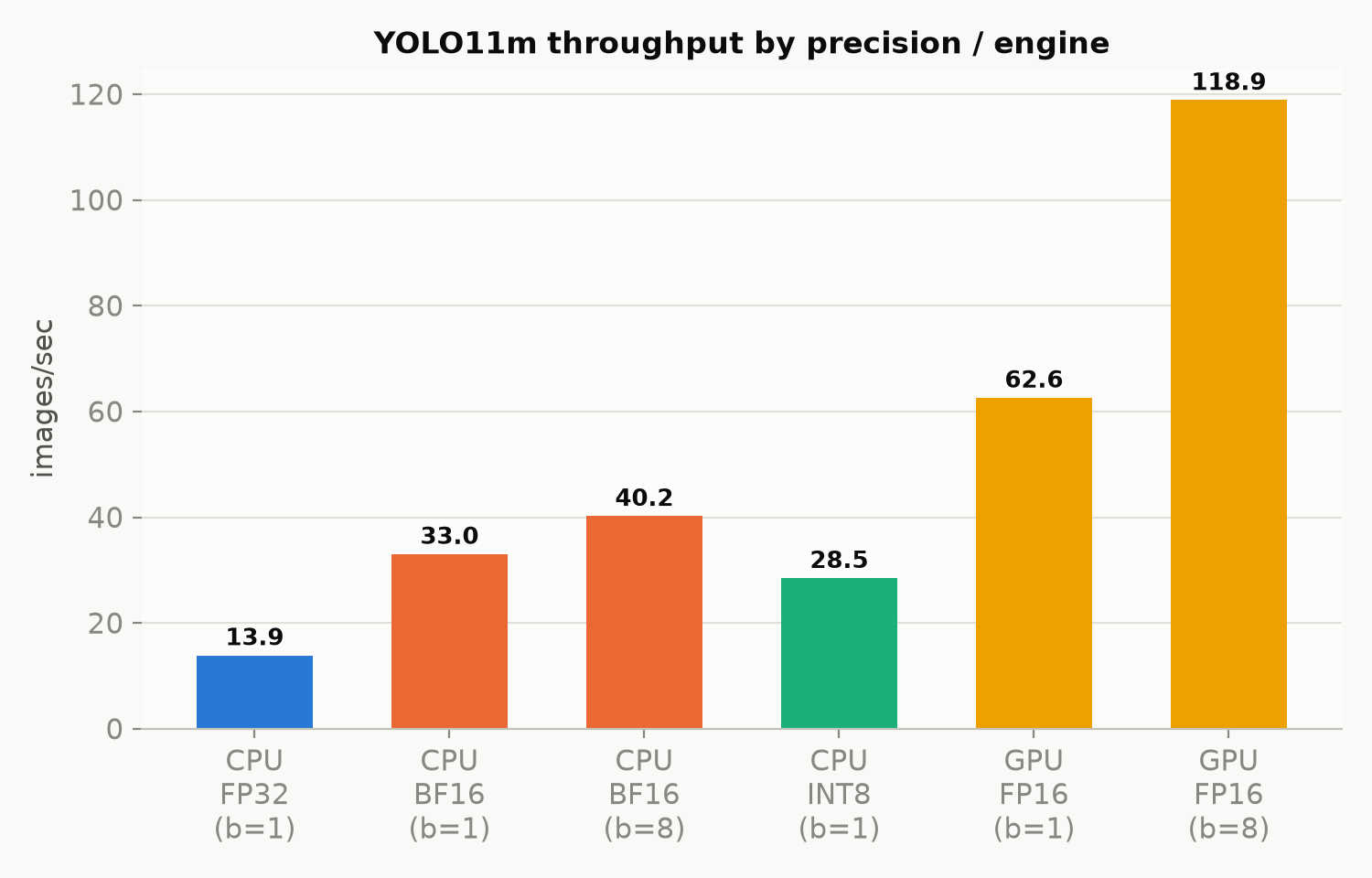
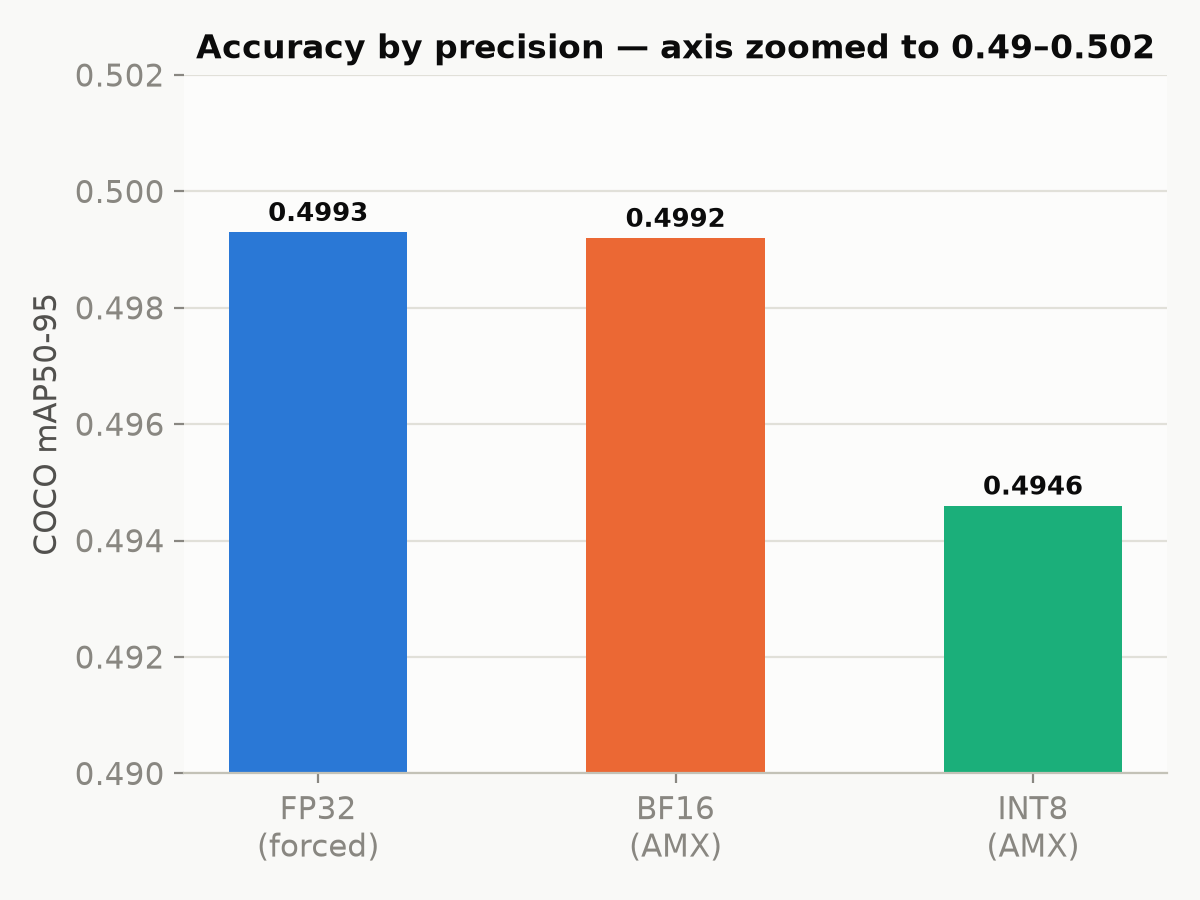
BF16/AMX gives a real 2.4–3.1x throughput gain over true FP32 on this hardware, at essentially zero accuracy cost (Δ mAP50-95 = −0.0001). INT8 costs a small but real −0.9% relative mAP and, counter to the usual expectation, ran *slower* than BF16 — the default quantization left some layers unquantized, introducing dequant/requant overhead that BF16's uniform precision avoids entirely.
GPU beats the best CPU path by ~3x at only 22–35% GPU utilisation — headroom-rich, with host-side pre/post-processing (letterbox, NMS) bundled into the reported figures alongside GPU inference itself.
3. Local volume vs Predastore-streamed
Same engines, now reading frames over S3 and writing detections back, instead of from the instance's own local Viperblock volume:
| Worker | Local images/s | S3-streamed images/s | Drop |
|---|---|---|---|
| gpu (TensorRT FP16) | 62.60 | 23.54 | −62% |
| cpu1 (OpenVINO BF16) | 33.02 | 13.44 | −59% |
| cpu2 (OpenVINO default) | ~34.79 | 13.44 | −61% |
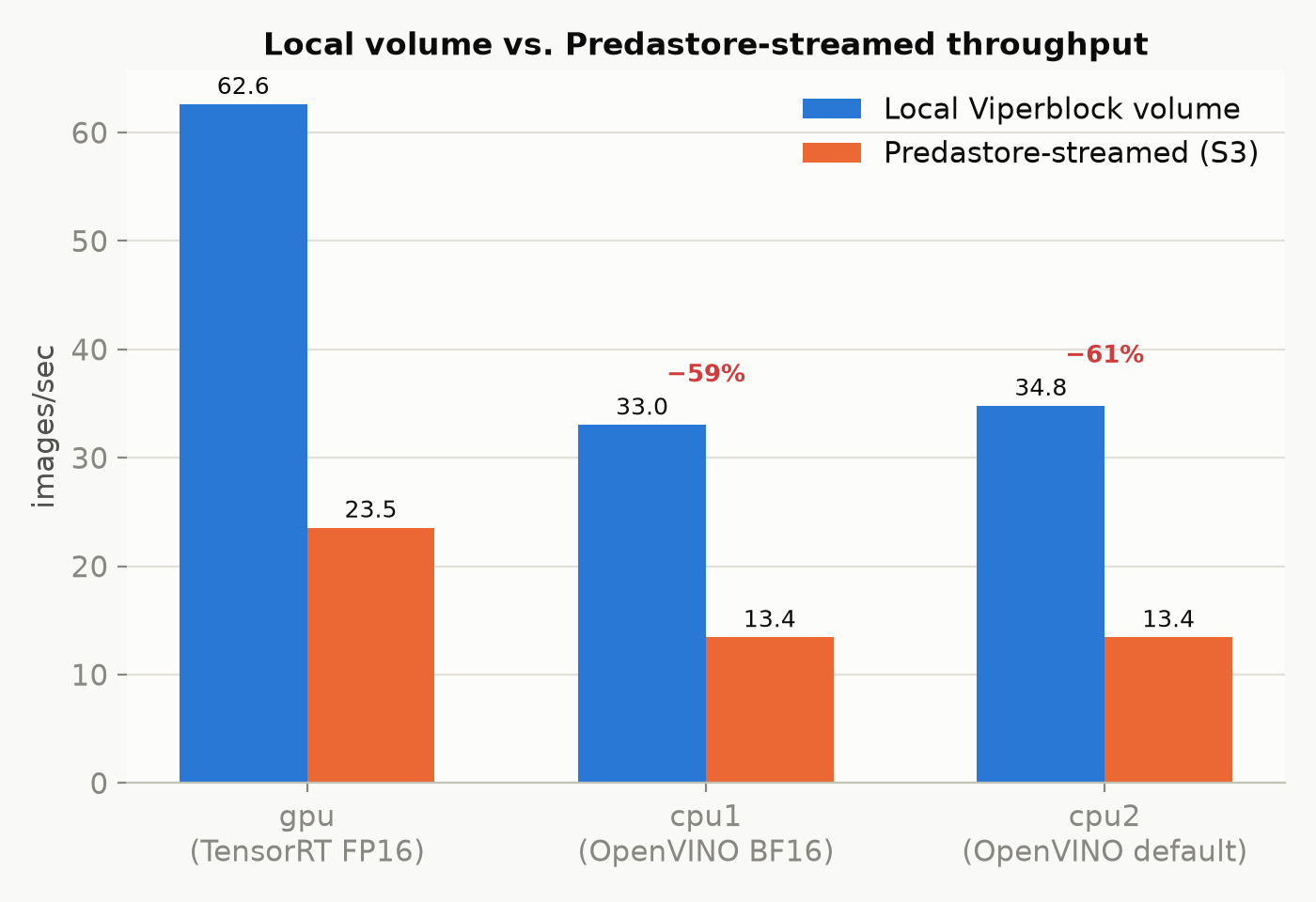
A solo cpu1 S3 run (no concurrent workers) scored 12.53 img/s — essentially identical to its 3-worker-concurrent number (13.44). Concurrency from the other two workers cost cpu1 almost nothing — the clearest evidence the storage-request latency itself, not contention between workers, is the limiter. Per-image latency breakdown confirms it: GPU's S3 round-trip (read+write ≈ 30.6 ms) is ~5x its actual inference cost (5.7 ms) — each frame is a small object (~163 KB), so this is a per-request-latency-bound access pattern, not a bandwidth-bound one. A production pipeline would batch/pipeline S3 reads rather than one GET per frame.
The ~30 ms round-trip at this object size (~163 KB) is dominated by fixed per-request cost — HTTPS/TLS, sigv4 signing, and the OVN gateway-chassis hop — rather than bandwidth. S3 latency grows only ~24–40% as workers scale while inference time grows ~11x, confirming the round-trip is a fixed per-request tax, not a contention effect.
4. Demo dashboard
cd demo-dashboard/
./venv/bin/uvicorn server:app --host 0.0.0.0 --port 8090
A local FastAPI dashboard renders the pipeline live: the annotated detection feed, the VLM's scene caption, GPU utilisation/power, Predastore CPU%, and per-instance Predastore GetObject latency.
Of particular note during the video below are the spikes in Predastore CPU %, attributed to its automatic compaction process.
5. Teardown
cd terraform/
terraform destroy
All three instances terminate and the NVIDIA L4 is immediately returned to the Spinifex GPU pool. The dedicated Viperblock data volumes (delete_on_termination = false) survive instance termination but are destroyed explicitly by Terraform here — any results or model artefacts worth keeping should be copied to Predastore before running this step.
6. Conclusion
This pipeline demonstrates a mixed CPU/GPU edge-AI workload — Intel AMX-accelerated detection and NVIDIA L4-accelerated captioning, running as independent EC2-compatible instances against a shared S3-compatible object store, on Cisco Unified Edge hardware managed entirely through standard AWS tooling. AMX delivers a real, accuracy-neutral 2.4–3x throughput gain on this hardware; the L4 leaves significant headroom at this workload's current scale; and streaming from a central bucket rather than a private local volume costs 59–62% throughput, because each frame is a small, latency- rather than bandwidth-bound request. Teams already operating AWS infrastructure can point their existing tooling at a Spinifex node with a single profile swap — EC2 instances, Viperblock EBS volumes, Predastore S3 buckets, and OVN VPC networking all provisioned from the same Terraform resources that work on AWS.